
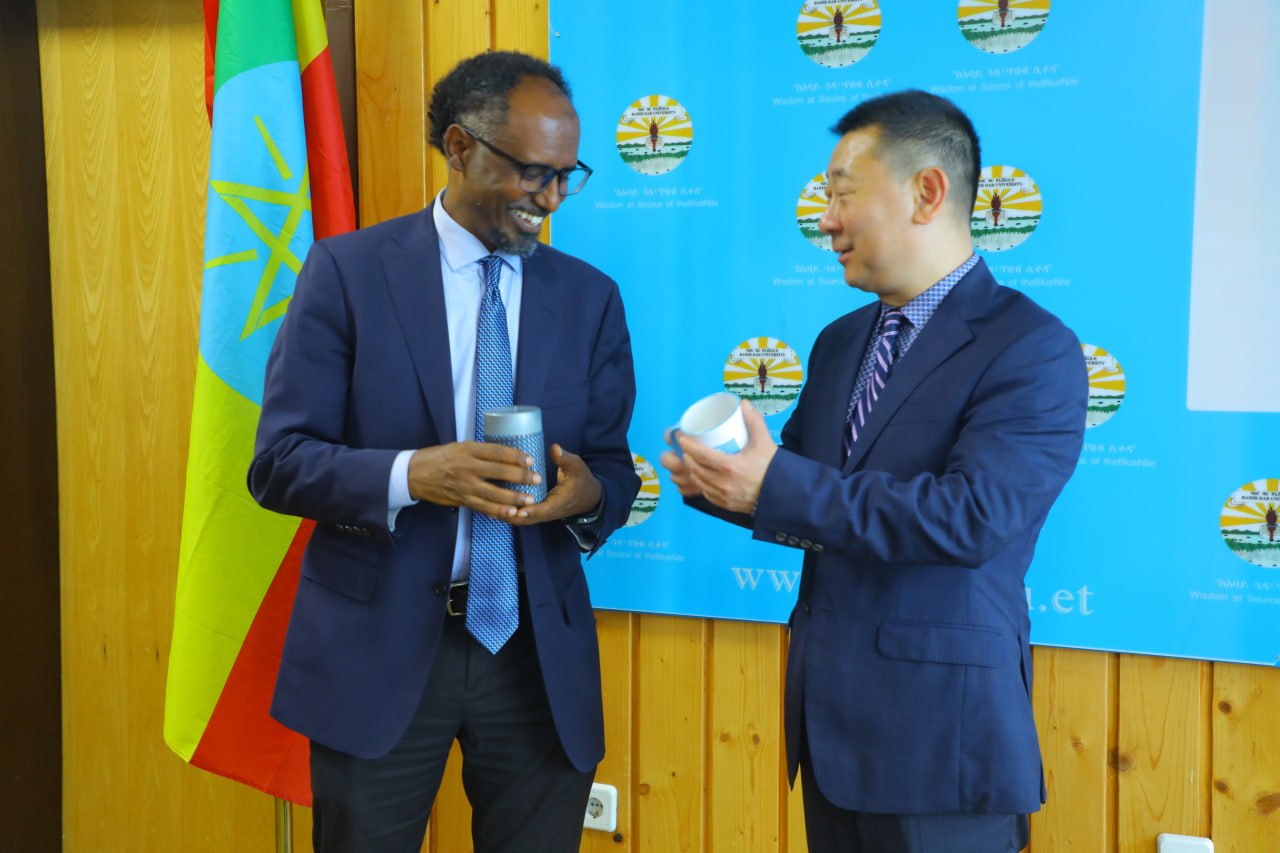
Chinese Embassy Delegation at BDU
01 Aug, 2026
Bahir Dar University Hosts Chinese Embassy Delegation: Strategic Dialogue Charts New Course for Sino-Ethiopian Academic Partnership
Bahir Dar University (BDU) had the pleasure of hosting a high-level delegation from the Embassy of the People's Republic of China in Ethiopia, led by Mr. Sun Mingxi, Minister and Deputy Chief of Mission (DCM), for a strategic dialogue and working visit with the University's team, led by its President, Dr. Mengesha Ayene. The seven-member delegation's visit highlighted the depth and dynamism of the growing partnership between BDU and its Chinese academic and institutional partners.
Welcoming the delegation, Dr. Mengesha Ayene remarked that the visit would open new horizons in joint research centers, technology transfer, staff mobility, and cultural exchange, further reinforcing the University's longstanding relationship with its Chinese partners. He noted that the visit carried great significance both for strengthening BDU's already established partnerships with Chinese institutions and for connecting the University with new ones.
The discussion, led by Dr. Mengesha, centered on several strategic pillars for deepening collaboration. Beginning with research and innovation, he proposed a joint innovation center for sustainable agriculture and water resource management, drawing on BDU's position within the Lake Tana and Blue Nile basin, and highlighted cooperation in the digital economy, artificial intelligence, and engineering-focused technical education. On academic mobility and capacity building, BDU proposed a sandwich PhD co-supervision model alongside short-term technical training placements in China for faculty and technical staff facilitated through the Chinese Scholarship Council (CSC). Dr. Mengesha underscored BDU's existing industry-collaboration model in textile and fashion technology with Donghua University as an example of the partnership model the University hopes to extend.
Turning to cultural and people-to-people ties, which he described as a human bridge between the two sides, Dr. Mengesha proposed the establishment of a Confucius Classroom or Chinese Language Center at BDU. He requested the Embassy's support in facilitating best-practice exchange with Ethiopian institutions that already host Confucius Classrooms, along with the provision of Chinese-language teachers, and noted the Embassy's continued role in linking BDU with relevant Chinese institutions. On partnership mechanisms, he noted that BDU currently maintains active collaboration with 13 Chinese institutions and organizations, as well as cooperation under the China-Ethiopia Inter-Governmental Science and Technology Innovation Cooperation program. He welcomed the Embassy's continued role in connecting BDU with additional Chinese institutions and affirmed the University's readiness to draft a joint implementation roadmap with the Embassy's education section.
For his part, Mr. Sun Mingxi briefed the University on key national-level frameworks shaping cooperation, including a newly signed five-year Ethiopia-China agreement integrating Chinese language education into the national curriculum, and a bilateral memorandum of understanding on digital transformation advancing fiber infrastructure, artificial intelligence, the Internet of Things, and big data under the Digital Ethiopia 2030 framework. The delegation affirmed its readiness to expand access to CSC opportunities through both Embassy/bilateral and university-to-university routes, describing the CSC as a bridge for BDU to engage with more Chinese universities. Mr. Sun also noted the Embassy's commitment to facilitating visa processing for outbound Ethiopian student and scholar applicants and reiterated readiness to explore prospects for a Confucius Classroom based on the signed agreement with Ethiopia.
Among the key strategic collaboration areas identified, both sides agreed to operationalize the BDU–Donghua University “Overseas College of Excellence in Engineering,” with BDU proposing that the Embassy help match the partnership with Chinese government funding streams under the Forum on China-Africa Cooperation (FOCAC) education pillar or the Belt and Road Initiative's human-resource development window. They also proposed a joint PhD supervision program in textile material science and water resources engineering, and agreed to advocate for a dedicated annual quota of CSC scholarships and Friendship Scholarships for BDU, targeting PhD candidates in textile and fashion engineering, water resources, agricultural economics, renewable energy and nuclear engineering, artificial intelligence, and data sciences; faculty exchange through three-to-six-month visiting professorships for BDU's Institute of Technology and the Ethiopian Institute of Textile and Fashion Technology (EiTEX); and short-term technical training of one to three months for laboratory technicians and industry liaison staff.
Following the discussion, the delegation toured the University's data center and the EiTEX, where members were introduced to BDU's achievements in textile innovation, applied research, and industry linkage. The visit concluded with both sides affirming a clear and shared direction for translating today's discussions into concrete joint action, reinforcing Bahir Dar University's standing as one of China's primary academic partners in Ethiopia and paving the way for a stronger, more actionable partnership in the years ahead.