English
 French
 German
About GDTC

Geospatial technology is changing our world; the way we live and work, the way we educate our students, and the way we "do" science. Geospatial technology is an umbrella term used to describe a range of modern mapping tools, which contribute to the geographic mapping and analysis of the Earth and human societies. The technology is the amalgamation of spatial technologies namely, Remote Sensing, GIS, GPS (Global Positioning System) and ground-based mapping. They are rapidly growing sub-fields with applications in environmental science, national security, demography, intelligence, forestry, natural resource management, disaster risk management, weather forecasting, traffic navigation, route mapping to online delivery environmental management, climatology, urban planning, criminal justice, food security studies, health, land use zonation, and agriculture, etc.
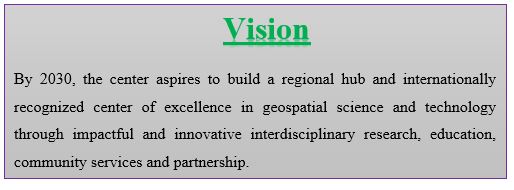
In this fast-paced world where changes in technology are the norm, Geospatial technology remains a stable and innovative research & development powerhouse that develops location-based technologies. Therefore, it is imperative that Bahir Dar University (BDU), which mobilizes all its constituent units and strives to accomplish its mission and realize the 2030 vision, has joined this new age of global exploration and scientific discovery and established the nation's leading geospatial research center to fulfill the promise as the national center for geospatial technology.
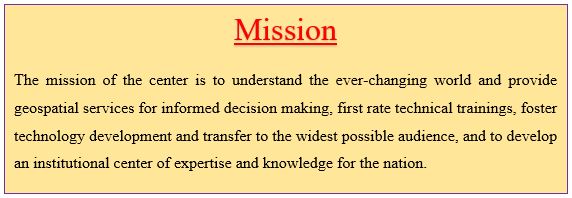
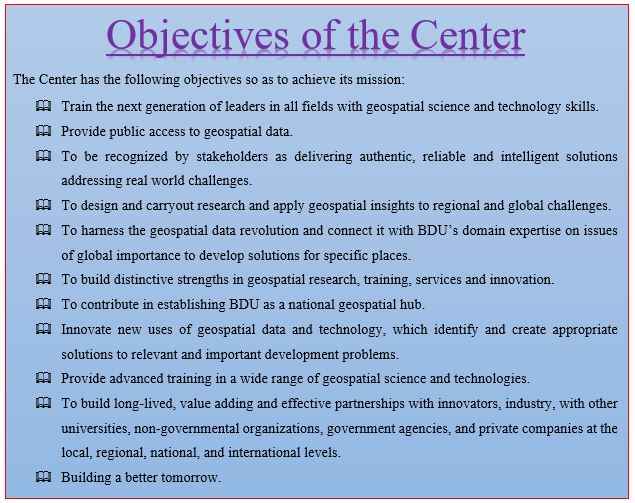
GDTC is an interdisciplinary center established to support the larger mission of BDU. Hence, since its inception, GDTC has promoted geographic thinking and the application of geospatial technology and science in interdisciplinary research, education and community service. Hence, the center seeks to bring together researchers from across BDU’s campus currently using geospatial data and technology, and provide a space to those who wish to apply geospatial technology in their research and community services. The center has also envisioned to become center of excellence in geospatial technology by providing: technical support for researchers, students and stakeholders; access to specialized geospatial equipment, software and laboratories; scientifically proven geospatial solutions using state-of-the-art technology; and a cutting-edge suite of geospatial servers and data repositories for advanced geospatial research and teaching for the entire BDU community and beyond.
Yet, for all that to work, BDU has vital and underpinning role of providing the underlying infrastructure, such as high performance computers and geodetic systems; as well as giving unreserved support for the establishment of a proper organizational structure with clear role and responsibilities, and proper channel of communication to ensure operations run smoothly and to assure its leadership in the provisioning of the geospatial technology service to the nation.